Wilson Schwegler
wschwegler21[at]gmail[dot]com
My name is Wilson, and I’m a second year M.S. student in Computer Science at UC Davis, where I conduct research in the VIA Lab. Previously, I earned a B.A. in Computer Science and Economics from Occidental College.
Research Projects
Pitch Sequencing Optimization and Visualization Tool
(In Progress) This project develops an execution aware, interactive pitch planning system that simulates complete at-bats. Using Statcast pitch characteristics, batter and pitcher profiles, game context, and prior pitch sequence, an outcome model estimates the probabilities of pitch level results and their run values. A separate command model uses computer vision derived inferred catcher targets (OpenCommand) to simulate where a pitcher is likely to actually locate an intended pitch, accounting for pitcher specific execution uncertainty. The system then recommends pitch type and target location based on the expected outcome after execution not simply the ideal target. Through an easy to use interface, users can select a matchup, choose or modify each planned pitch, view simulated locations and outcome probabilities, and progress through an at-bat pitch by pitch.
LLNL Internship
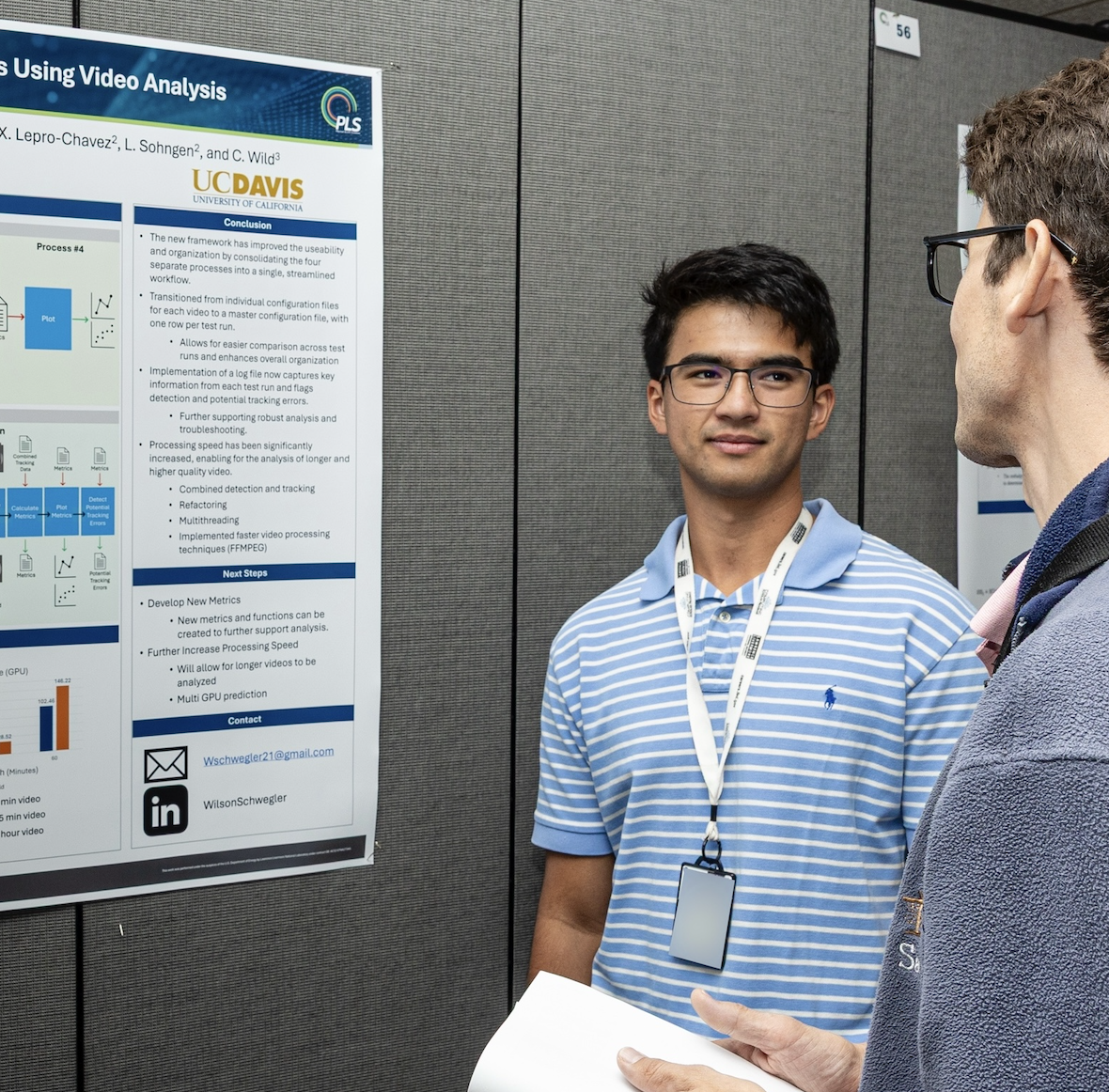
Developed an in situ monitoring system using computer vision to track high-density carbon target capsules during chemical vapor deposition. Created metrics to characterize capsule movement and interactions, then used linear, ridge, and lasso regression on limited experimental data to predict capsule quality and identify behaviors associated with higher quality capsules. Built a user interface and ML assisted labeling tool so non-technical users could analyze experiments and curate training data. Improved processing speed by up to 2.3× through multi-GPU support, multiprocessing, and code refactoring. Presented the work at the LLNL summer research poster session, earning second place in the Graduate Student People’s Choice Award.
Quantifying Stylistic Differentiation in MLB Pitch Profiles
This project introduces Unique+, a descriptive metric designed to quantify stylistic differentiation in MLB pitch profiles using k-nearest neighbors in standardized pitch shape space. The model constructs high-dimensional pitcher season feature vectors from Statcast derived pitch characteristics and measures structural distance relative to same handedness peers. While Unique+ only adds modest explanatory power for run prevention beyond Stuff+ and velocity, the framework generates interpretable similarity relationships that can inform player comps, development strategy, and bullpen or rotation construction.
 View Article →
Uncertainty Aware Forecasting of MLB Pitcher Value Using Pitch Level Information
(Inprogress) This project studies uncertainty-aware forecasting of MLB pitcher value by modeling next-season fWAR as a distributional prediction problem using quantile regression and conformal calibration. It compares nested feature sets, moving from season-level statistics to basic pitch-level characteristics, to evaluate how added pitch information affects the sharpness and quality of prediction intervals. Preliminary results indicate that incorporating basic pitch-level features leads to narrower prediction intervals and lower Winkler scores, with modest improvements in median error, particularly for starting pitchers.
View Case Study Blog →
 View on GitHub →
Comparing a Neural Network and a Graph Neural Network for Predicting PFAS Bioactivity
This project evaluates the effectiveness of a traditional neural network versus a graph neural network for predicting the bioactivity of PFAS molecules, which are environmentally persistent chemicals linked to serious health risks. Using a large PFAS bioassay dataset, the models are compared under different precision–recall tradeoffs, showing that neural networks are better at minimizing false positives while graph neural networks excel at identifying active molecules when recall is prioritized. The results highlight how model choice should depend on the specific scientific or regulatory goal of PFAS screening.
View on GitHub →